

Model
Most companies talk about AI.
We talk about results.
AIghty20 Elevate is a structured model that helps organizations use AI in a meaningful, effective, and sustainable way - not as a toy, but as a real productivity lever.
Not tool-first.
Not hype-driven.
Impact-driven.


Why most AI initiatives fail
And what we do differently.
The core problem
a tool here
a workshop there
no ownership
no clarity
What AIghty20 Elevate does differently
What impact should AI create?
Where does inefficiency exist today?
What's blocking adoption?
What needs organizational clarity first?
Enabling
How the model is applied
Decision basis
Implementation framework
Structural backbone
Who the model is for
Companies under real pressure to deliver
Leaders looking for direction
Organizations ready to scale
The model in one sentence:
AIghty20 Elevate connects thinking, capability, and execution into measurable impact - every day.
Impact isn't luck.
Impact is engineered.
AI doesn't create value through features. It creates value by changing how work gets done. The AIghty20 Elevate model pinpoints exactly where and how real value is created - measurable, traceable.

Focus on the levers that matter

Impact you can measure and control

Anchored in daily operations
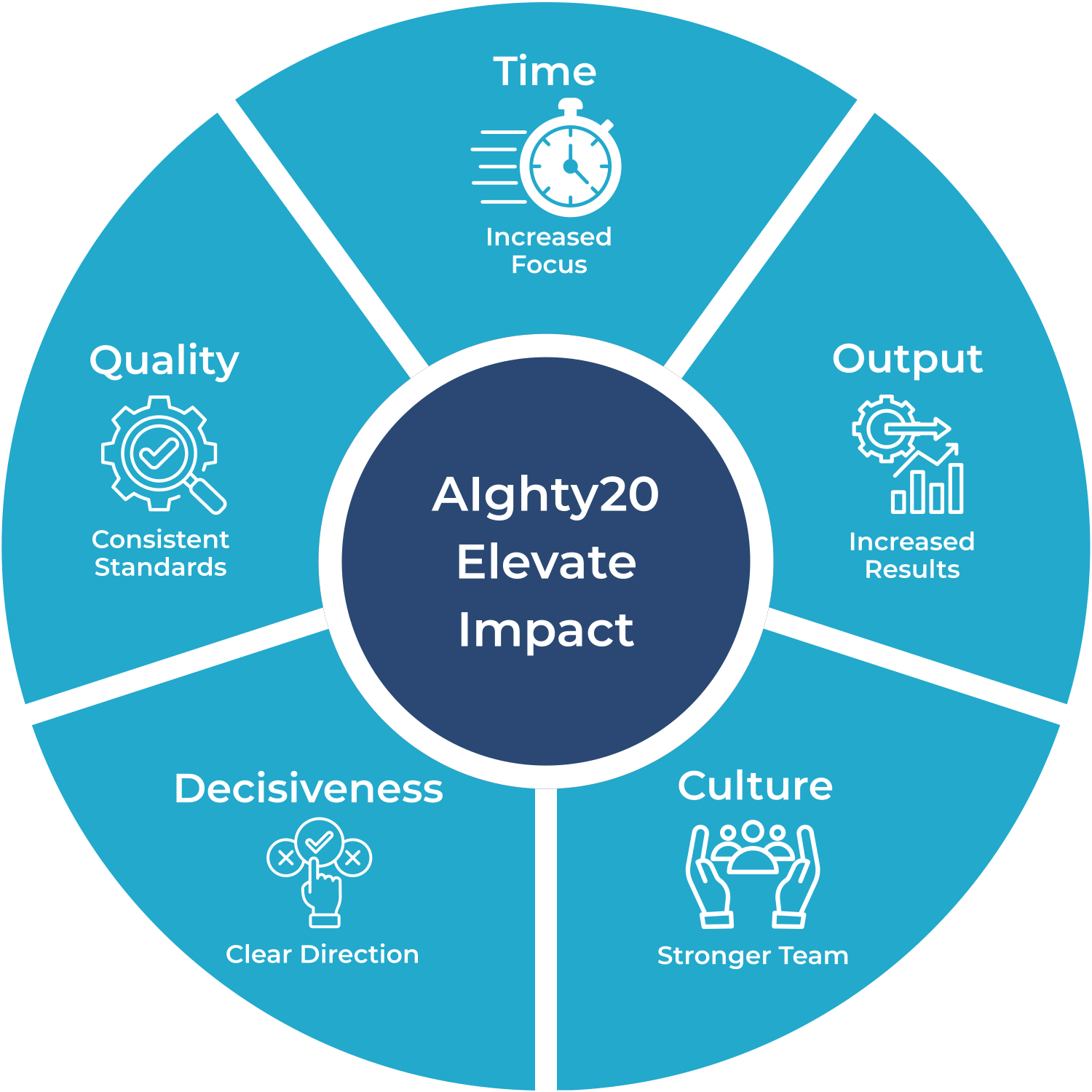

Impact Dimension: TIME
Get oriented before you decide.
Before AI gets discussed, it needs context.
Core Thesis
AI doesn't just save time.
It eliminates unnecessary work.
Time pressure is rarely a capacity problem.
It's almost always a structural one.
AI creates impact where work is:

Only scalable to a limited degree
Dependent on preparation, with quality riding on a single person's head
speed is limited
Typical Symptoms
When time is the problem, you see it immediately:
Meetings without prep
Manual groundwork for simple tasks
Copy-paste work
Too many alignment loops
Constant interruptions
"I never get to the real work"
Important:
These are not individual weaknesses, but systemic inefficiencies.
Where AI actually applies
AI doesn't hit time in isolated spots. It acts across the entire workflow:
Preparation
Structuring
Information processing
Support
Acceleration
Fewer manual steps
Downstream processing
Documentation
Summaries
Important:
Time is saved not by typing faster, but by reducing the need to think about trivialities.
The real impact
The biggest effect isn't time saved. The biggest effect is focus.
Fewer context switches
Less prep stress
Less rework
more focus on value creation
Important:
Time is the most visible effect. Focus is the most valuable.
Measurability
Time impact is measurable - if you're honest about it:
Task turnaround times
Number of manual steps
Prep time per meeting
Processing time per process
Repetition overhead
Impact:
Culture is the slowest lever – but the most important.
Typical false assumptions
Time pressure is rarely a capacity problem. It's almost always a structural one.

"AI makes everything faster"
"We save time automatically"
"One tool is enough"
The Truth:
Without clarity, you get new chaos
Without enabling, you get frustration
Without integration, the effect fizzles out
Time is the first impact - never the only one.
Time is the first proof that AI works.
But only if it is used correctly.

Impact Dimension: Output
More results per person.
Not more rush.
Core Thesis
AI doesn't increase output by making people work faster. It increases output by generating more results with the same energy. Output problems are rarely effort problems. They're scaling problems.
AI creates impact where work:
is only scalable to a limited degree
needs prep, with quality riding on a single person's head
is speed-limited
Typical symptoms
When output is the problem, you hear sentences like:
"We can't keep up"
"So much just sits there unfinished"
"Good ideas, no capacity"
"Everything hangs on one or two people"
"We could do more, but..."
Important:
These are not individual weaknesses, but systemic inefficiencies.
Where AI Actually Applies
AI hits output at three points at once:
Multiple variants at once
Multiple perspectives
Multiple drafts
Rough drafts
Structure
initial analyses
Reproducible quality
Standardized output
Consistent task handling
Important:
Output becomes predictable, not random.
The actual impact
The biggest effect is not time savings.
The biggest effect is focus.
fewer context switches
less preparation stress
less rework
more focus on value creation
Important:
Time is the most visible effect.
Focus is the most valuable.
Measurability
The impact of time can be measured – to be honest:
Deliverables per time unit
Variants produced per task
Throughput per person or team
Reuse rate of preliminary work
Quality variance across people
Impact:
What scales no longer depends on one person.
Typical Misconceptions
“More output lowers quality”
“AI makes everything generic”
"More output only matters for marketing"
The reality:
Quality only becomes controllable once there's selection to choose from
AI delivers raw material - people deliver judgment
Output affects every role, not just marketing
Output isn't a result of effort.
Output is a result of the system.

Impact Dimension: QUALITY
Better decisions.
More consistent delivery.
Less rework.
Core Thesis
AI doesn't raise quality through perfection.
It raises quality through structure, comparability, and clarity.
Quality problems rarely happen because people are bad at their jobs. They happen because:
Decisions get made under time pressure
Standards are missing
Comparability is missing
AI creates impact wherever quality needs to be systematically secured.
Typical Symptoms
When quality is the problem, you hear sentences like:
"It depends heavily on who's doing it"
"You never know what you'll get"
"We always have to sharpen this up"
"Too many rounds of revision"
"Good, but..."
Important:
These are not individual weaknesses, but systemic inefficiencies.
Where AI Actually Applies
AI doesn't improve quality at the end. It improves quality before and during the work.
Clear outlines
Clean logic
Consistent criteria
Multiple variants
Different perspectives
Clear distinctions
Same quality criteria
Same tone
Same standards
Important:
Good quality doesn't start with the text, but with the structure. Quality is a result of choice, not by chance. AI makes quality reproducible.
The real impact
Quality isn't an end in itself. It has direct business impact:
Less rework
Less back-and-forth
Fewer correction loops
higher reliHigher reliabilityability
And crucially:
Trust increases – internally and externally.
Measurability
Not perfect. But enough to steer by:
Number of correction loops
Post-processing time
Consistency across multiple outputs
Adherence to defined criteria
Feedback quality (not taste)
Impact:
Culture is the slowest lever – but the most important one.
Common misconceptions
Quality often gets treated as a matter of taste. It's almost always a structural problem.
"AI lowers quality"
"AI makes everything generic"
“Increased output is only relevant for marketing”
The reality:
Quality only becomes controllable once there's selection to choose from
AI delivers raw material - people deliver judgment
Quality becomes subjective in the absence of standards
Quality isn't created by control. It's created by good structure.

Impact Dimension: DECISION
Decide with clarity. Act faster.
Own the outcome.
Key Thesis
AI doesn't make decisions.
But it makes decisions better.
Bad decisions rarely happen because information is missing. They happen because:
information is unstructured
Perspectives are missing
Uncertainty dominates
AI creates impact wherever decisions today run on gut feeling instead of grounding.
Typical symptoms
When decisions are the problem, you hear sentences like:
"We keep going in circles"
"We don't have a basis to decide on"
"We need more information"
"We need to align on this again"
"Nobody wants to make the call"
Important:
These are not individual weaknesses, but systemic inefficiencies.
Where AI actually applies
AI doesn't replace ownership.
But it massively improves the quality of preparation.
Organizing information
Making connections visible
Prioritizing relevance
Scenarios
Counterarguments
Alternatives
Opportunities
Risks
Impacts
Important:
More information is worthless if no one has an overview. Good decisions arise when more than one perspective is available. AI compels making the implicit explicit.
The Real Impact
The biggest effect isn't deciding faster. The biggest effect is deciding calmer.
Fewer endless discussions
Less gut feeling
Less office politics
More ownership
Decisions become:
Traceable
Communicable
Understandable
Measurability
ot mathematical.
But organizationally clear:
Duration of decision processes
Number of revision loops
Clarity of decisions made
Speed of implementation
Corrections made after the fact
Impact:
Culture is the slowest lever – but the most important.
Typical False Assumptions
Bad decisions are rarely a knowledge problem. They're almost always a structural one.
"AI decides for us"
"More data = better decisions"
"Decisions are purely a matter of experience"
The Reality:
AI is a sparring partner, not a decision-maker
Relevance beats data volume
Experience is strengthened when structured
AI doesn't take the decision off your hands. It takes the uncertainty off your hands.

Impact Dimension: CULTURE
Create safety.
Build trust.
Normalize usage.
Core thesis
AI doesn't fail because of technology. It fails because of culture.
AI fails wherever:
Uncertainty dominates
Leadership is unclear
Usage isn't legitimized
AI is effective where quality needs to be systematically ensured.
Typical Symptoms
When culture is the problem, you hear sentences like:
"Am I even allowed to use this?"
"What happens if I get it wrong?"
"Nobody actually does this anyway"
"Officially we can't, unofficially we do"
"Leadership doesn't even use it themselves"
Important:
These are not individual weaknesses, but systemic inefficiencies.
Where AI Actually Applies
Culture isn't created through communication.
It's created through behavior.
AI shapes culture in three places:
Does leadership use AI visibly?
Does it discuDo they talk about it openly?ss it openly?
Do they set clear guardrails?
hat's allowed
what isn't
where the boundaries are
Mistakes get punished
Experiments get ridiculed
Uncertainty isn't allowed
Important:
Without legitimacy, shadow usage emerges. Unclear rules create fear. Fear prevents adoption.
Space to learn
Protection
Uncertainty is not allowed
The Real Impact
The real culture effect is initiative. What changes:
People start experimenting
Knowledge gets shared
Use cases emerge bottom-up
AI becomes routine, not a project
AI is no longer 'rolled out'. It is used.
Measurability
Not soft-pedaled. Pragmatic:
Actual usage instead of license counts
Number of internal use cases
Voluntary knowledge sharing
Participation without mandate
Questions asked instead of silence
Important:
Culture shows up in behavior - not in surveys.
Typical False Assumptions
"Culture happens on its own"
"A few workshops are enough"
"People just need to want it"
The truth:
Culture is leadership's responsibility
Culture needs structure
Culture needs role models
Not every company starts at the same point.
But every company needs a clear direction.
Adopting AI isn't a sprint. But it isn't an endless project either.
The AIghty20 Elevate Journey shows how organizations get guided through the modules with purpose - adapted to maturity level, objective, and pace.
Awareness
Readiness
Enablement
Execution
Automation
Integration
Scale
Governance
Facts, not assumptions.
Forget gut feelings. Use data. We provide you with the tools to not only see AI potential, but to calculate and scale it.
Ready for true leverage?
Take your focus to the next level.
Let's secure your advantage. Schedule
an appointment for your Focus Check now.