Your AI Problem Isn't Too Little Data - It's Too Little Clarified Knowledge
More documents don't make your AI smarter, only more confident when it's wrong. Why the real problem is clarification - and who's liable when the spoken number was false.

One reflex accompanies almost every mid-market AI project. If the answers are bad, we dump more documents into the system. More handbooks, more reports, more minutes, more email threads.
The assumption: more information yields more intelligence.
It's wrong. More documents don't make your AI smarter. Only more confident when it's wrong. Most companies don't have a volume problem. They have a clarification problem.
Information isn't knowledge
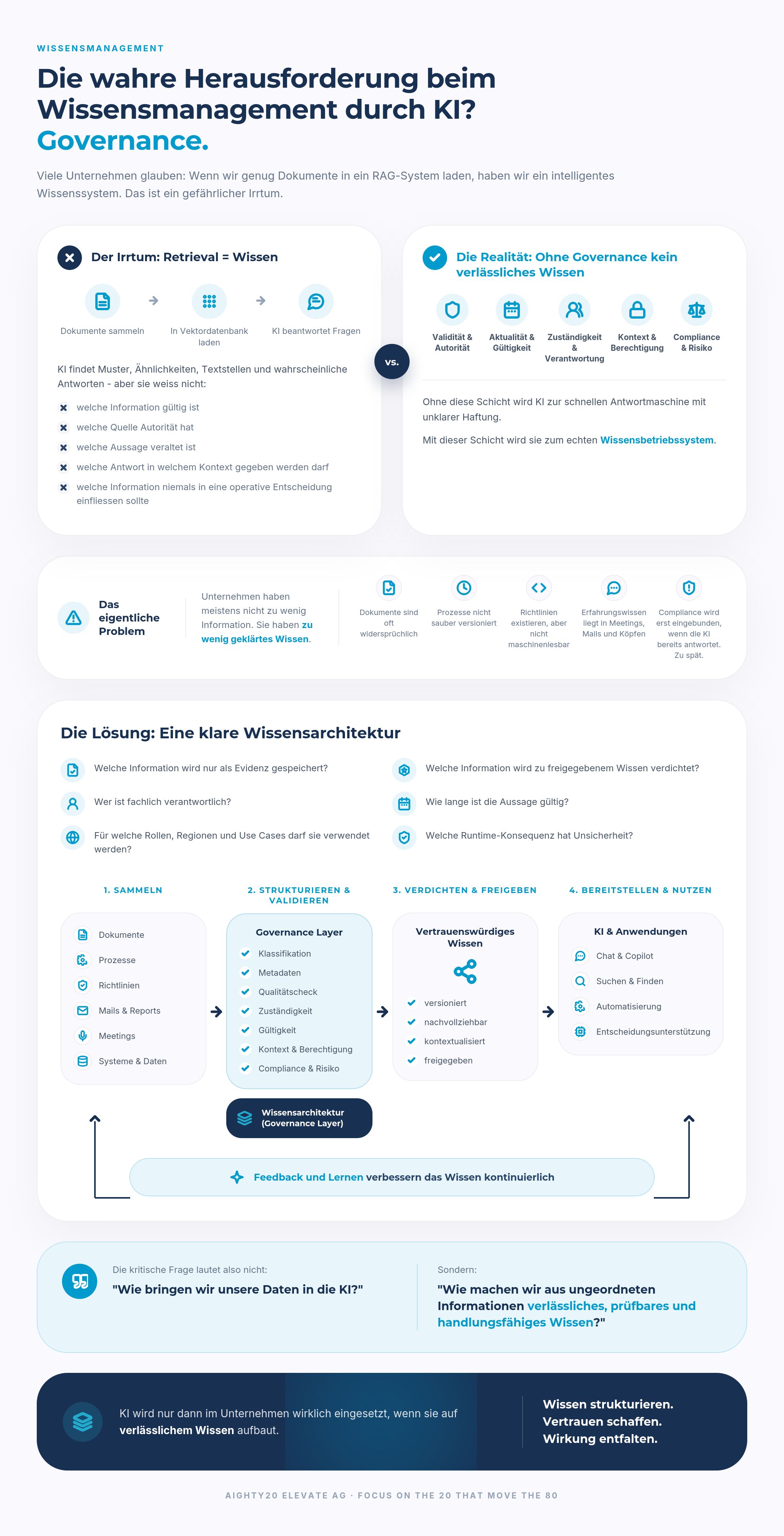
The machine finds patterns, similarities, passages and probable answers.
What it doesn't know: which information is valid and which is obsolete. Which source carries authority - the official process, or the email in which someone granted an exception. Who is professionally responsible and stands behind the statement. In what context and for which role an answer may be given. Which information should never, for compliance reasons, feed an operational decision.
A pile of documents answers none of these questions. It sharpens them. Company data contradicts itself. Processes are rarely versioned. Policies exist, but not machine-readable. The most valuable experience sits in meetings, emails and heads.
Let the AI loose on that pile and it delivers fast answers of unclear origin. That isn't intelligence. That's an answer machine without accountability.
An example everyone knows. Asked "what's our discount latitude for new customers?", the system finds three sources. A pricing policy from 2023. A more recent slide from a sales meeting. An email in which a sales lead approved 20 percent for one specific case.
All three are similar to the question. RAG has no reason not to output the email as the rule. It's in the index, after all. A human would know instantly which source governs. The system doesn't. Nobody told it what carries authority and what is merely evidence.
The question that decides everything: who's liable?
The system answers "what was our revenue in the second quarter?" Someone acts. Corrects a forecast. Approves an investment. Quotes the number to the bank.
And the number was wrong.
Who's liable?
With a dashboard the answer is clear. Defined metric, defined source, someone signed off. With an AI that assembles a plausible number from a heap of documents, nobody knows exactly.
Without a layer that establishes what governs and who is responsible, AI becomes a fast answer machine with diffuse liability. Under Swiss and EU data protection law that isn't a theoretical risk.
What a governance layer actually does
The missing piece isn't a bigger vector index. It's a knowledge architecture - a governance layer between the raw information and the answering AI. Its job isn't to find more. It's to clarify.
Collect. Documents, processes, policies, emails, meetings, system data.
Structure and validate. Classify. Attach metadata. Check quality. Assign ownership. Establish validity and permission. Flag compliance risk.
Consolidate and approve. Vetted knowledge becomes a trustworthy, versioned state. What is evidence stays evidence. What is approved gets used.
Serve. Only now does the AI reach in. Into clarified knowledge, not a heap.
The difference in outcome is fundamental. Without that layer: an answer machine with unclear liability. With it: a system whose answers are vetted, provable and defensible.
This clarification isn't a project. It's a loop. Every use produces feedback - a correction, a follow-up question, a "that's not right." That is precisely what improves the clarified knowledge further. Governance isn't a binder you fill once. It's a process that makes the system more reliable every week. Mistake it for a static compliance exercise and you've built a brake instead of an engine.
Where we stand
Most vendors sell you the answer machine and leave you the liability. We think that's the wrong order.
From our partnership with Overmind we know the governance architecture that clarifies knowledge before the AI answers. In the DACH context, that clarification is exactly the difference between a useful tool and a compliance risk with a voice output.
The critical question isn't "how do we get our data into the AI?" It's: how do we turn disordered information into reliable, verifiable knowledge? The first question solves a technical problem. The second solves your actual one.
Swiss and EU data protection law demand proof of the basis on which a decision was made. An AI that doesn't know its source isn't just imprecise. It's a documented risk.
Governance, then, isn't optional polish. It's the entry ticket for regulated use - the difference between "let's try some AI" and "we deploy AI where money and liability are on the line."
Your next step
Before you feed knowledge into an AI: know how clarified it is.
Our data protection compliance asset suite - checklist, maturity scoring, ready-made deliverables - gives you the honest status report. Where is your knowledge verifiable? Where is it liability? And what do you clarify before an AI answers on top of it?
Links
Here you can find more information
Our Stance. No Bullshit.
We filter out the noise. Here you'll find our unvarnished opinion on AI, scaling, and efficiency. No empty buzzwords. Just the 20% that truly make a difference.
Facts, not assumptions.
Forget gut feelings. Use data. We provide you with the tools to not only see AI potential, but to calculate and scale it.
Ready for a system instead of piecemeal solutions?
Take your focus to the next level.
We integrate strategy, enablement, and technology into a single unit. For lasting results.
Schedule a Focus Check.