Voice AI Isn't a Dictation Tool - It's Your New Interface
Nine out of ten people think voice AI means dictation. The real leverage sits elsewhere: an interface across your entire stack, one you speak to instead of operate. Seven capabilities - and the one prerequisite.

Ask ten people what voice AI means in a company. Nine will say: dictating instead of typing. Speaking emails, capturing notes, transcribing minutes.
Nice. Time-saving. And the warm-up, not the point.
The leverage is elsewhere. Voice AI isn't the faster input device. It's the interface to your entire stack.
From typing to asking
"What was our revenue in the second quarter?"
Today the answer is a procedure. Someone opens the BI tool. Picks the dashboard. Sets filters. Reads off the number. Pastes it into an email. Three minutes, if everything cooperates. Five clicks and a login, if it doesn't.
With voice as an operating layer, that becomes one sentence. You ask. You get the answer - spoken, with context, no dashboard.
It sounds like convenience. It changes who can reach data at all. The executive team. The field rep in the car. The warehouse lead with both hands full. Between them and the information stood a piece of software you had to know how to operate. Speech removes that barrier.
The difference from a smartphone assistant is fundamental. That one you ask about the weather. An enterprise-grade voice layer you ask about things only your company knows. They're only worth something if the answer is correct, authorized and traceable. Same gesture. Entirely different requirement.
What an interface actually means
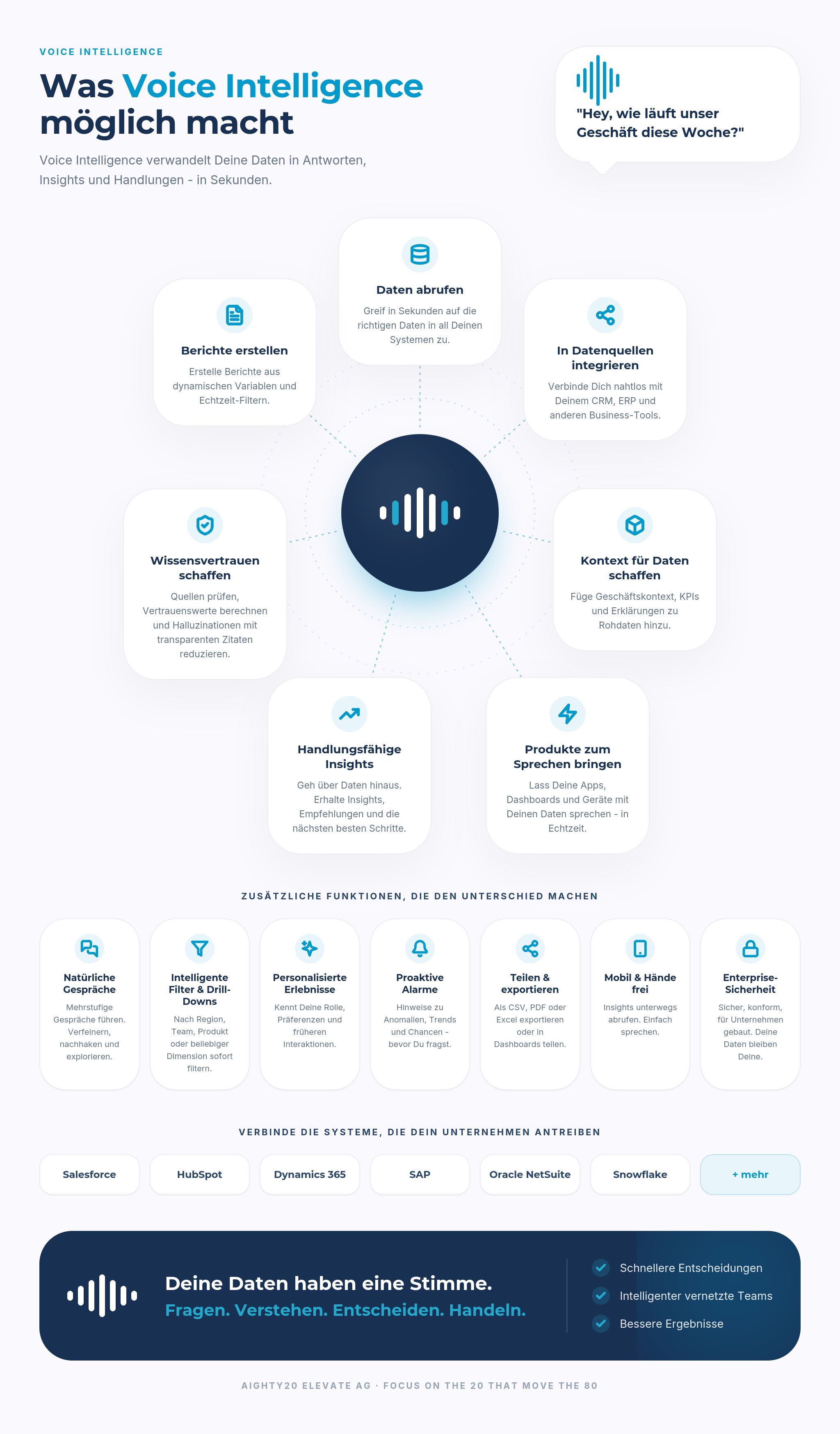
Seven capabilities make voice more than dictation.
Retrieving data. The right information from every system, in seconds. "How many open proposals above 50,000 are sitting in the pipeline?"
Generating reports. Dynamic filters, real time, by voice instead of a click path. "Contribution margin by region, this quarter against last."
Integrating sources. Voice is only as good as what it hangs on. The leverage appears when one question runs across CRM, ERP and BI.
Creating context. Raw data is rarely the answer. Business context and KPI logic turn a number into a statement. "Is that good?" is a legitimate follow-up.
Delivering insight. Where's the deviation. What's the likely cause. What's the next step. Data that triggers nothing is expensive ballast.
Working hands-free. Hands busy, eyes elsewhere. In the warehouse, the car, the workshop.
Staying mobile. The answer arrives where the question was born.
Each capability alone: a small gain. Together: a layer above your stack that you speak to instead of operate.
The prerequisite nobody enjoys hearing
The answer has to be real.
This is where this piece connects to part one of the series: Why "Talk to Your Data" Usually Doesn't Deliver. A spoken interface built on probable rather than correct data is more dangerous than none. It radiates a trust it cannot back.
Operating layer doesn't mean "strap a language model onto the documents." It means real system queries, clean permissions, traceable answers. And a voice on top that makes it accessible.
Order decides. Architecture first. Then the voice.
An example. The field rep asks on the way to a client: "What was our last revenue with this company, and are there open complaints?" That single question runs across CRM, ERP and the ticket system. If it works reliably, it doesn't save three minutes - it changes how prepared someone walks into a conversation. If it only works most of the time, it's worse than useless. People rely on it anyway.
The value of an interface isn't measured by the ideal case. It's measured by what you can lean on blindly in daily business.
Where we stand
Voice projects rarely fail on the technology. They fail on the expectation.
Introduce voice as a dictation feature and you get a dictation feature. Then you wonder where the transformation went. Think of voice as an operating layer, and you do the unsexy work first: connect the data sources, define the context, settle the permissions.
That's where we come in. From our partnership with Overmind we know the architecture that carries this layer. Our job: finding the use cases with you that justify the effort. And the ones that don't.
Not every question belongs on a voice interface. The right ones change how fast your company gets from a question to a decision.
Your next step
The honest question isn't "do we want voice?" It's: which of our recurring questions do we actually answer better by voice - and is the data behind them ready?
Our Voice AI Readiness Check turns that into a concrete list. You see which use cases fit your setup, where the leverage is greatest, and where the data foundation doesn't hold yet.
Links
Here you can find more information
Our Stance. No Bullshit.
We filter out the noise. Here you'll find our unvarnished opinion on AI, scaling, and efficiency. No empty buzzwords. Just the 20% that truly make a difference.
Facts, not assumptions.
Forget gut feelings. Use data. We provide you with the tools to not only see AI potential, but to calculate and scale it.
Ready for a system instead of piecemeal solutions?
Take your focus to the next level.
We integrate strategy, enablement, and technology into a single unit. For lasting results.
Schedule a Focus Check.