Why Voice AI Finally Feels Fast Enough
Depth or speed - that trade-off just died. Fast talker up front, deep thinker behind, policy gate in between. Plus the honest caveat: speed without correctness is accelerated error.

Voice AI isn't new. Voice assistants have been around for over a decade. The experience is the same everywhere: charming for a timer, useless for anything that counts.
The reason was a trade-off that looked unsolvable. It just died. And that explains why voice is turning from toy into tool right now.
The old trade-off: depth or speed
A good answer to a business question needs depth. Find the right data source. Filter cleanly. Account for context. Research across systems. That costs seconds.
A conversation tolerates no seconds. Three seconds of silence is uncomfortable. At five you assume the line went dead. Speech lives on immediacy.
Deep research and low latency were mutually exclusive. Either the answer came fast and stayed shallow. Or it got thorough, and the conversation collapsed under the waiting.
Early voice systems therefore felt either stupid or sluggish. Both are useless in operations.
The architecture that dissolves the conflict
The breakthrough isn't a faster machine. It's a different division of labor.
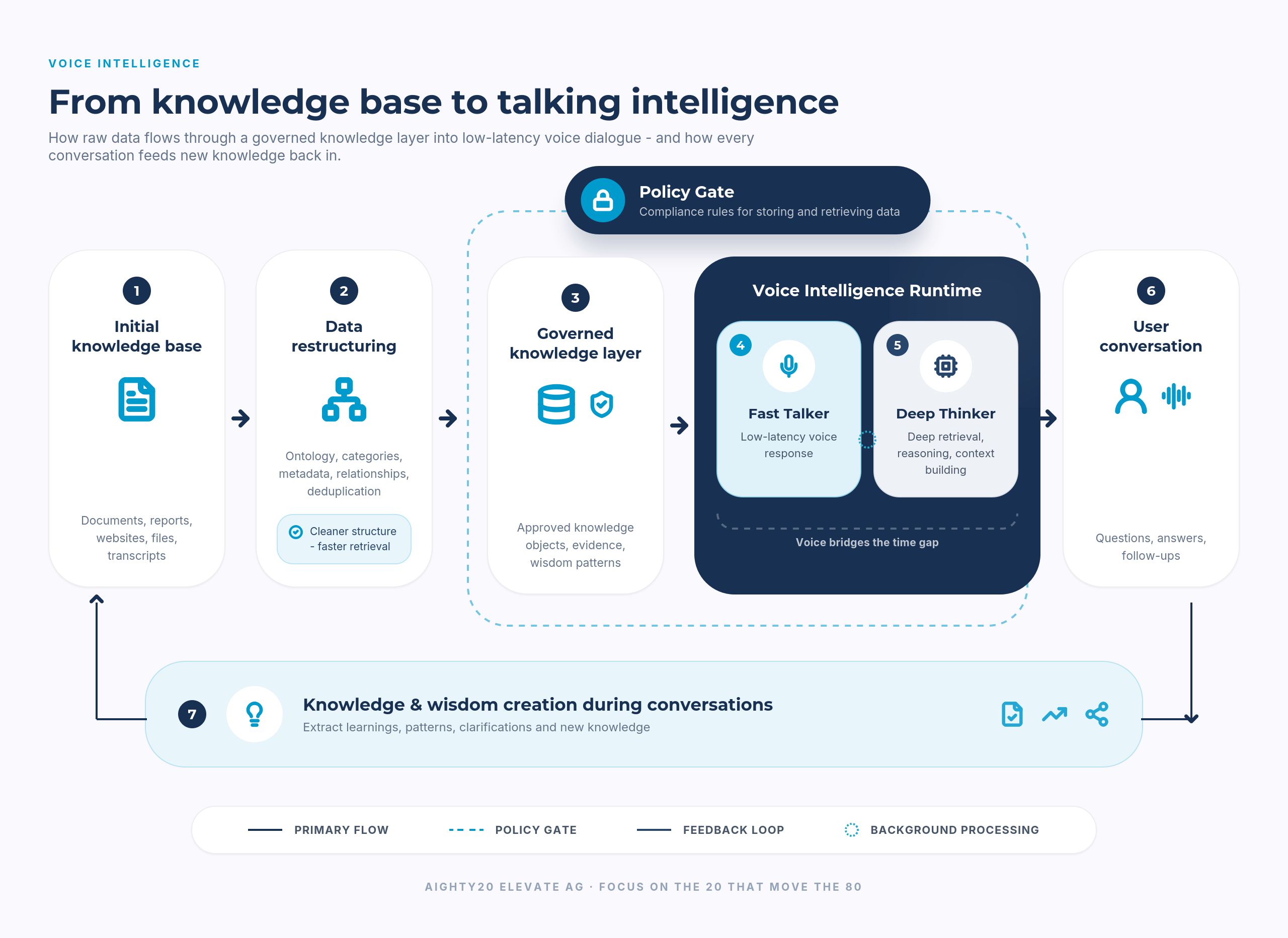
Instead of forcing one system to be fast and deep at the same time, the modern voice runtime splits the task.
The fast talker sits up front. Optimized for low latency. It keeps the conversation moving, confirms the question, delivers immediately what's already clear. It bridges the wait the way a human would - the one who says "hold on, let me check" rather than sitting there mute.
The deep thinker works behind it. Optimized for thoroughness. Deep reasoning, real data queries, context across systems. It takes the time a defensible answer requires.
Between them sits the policy gate. It enforces which data may be stored and retrieved. Convenience at the front doesn't override permissions at the back.
Overmind puts the result well: voice bridges the time gap. The voice fills exactly the seconds in which the work runs in the background.
Concretely: you ask. In fractions of a second the fast talker confirms and starts with what's clear. During the two or three seconds the deep thinker needs, there's no dead silence but conversational flow. Just as a good employee says: "let me check, it was a bit lower last quarter" - while looking up the number.
Perceived waiting time drops dramatically. Actual compute time stays the same. It's exactly that feeling - the machine isn't leaving me hanging - that decides whether people use a voice system or give up after three tries.
Why that makes the difference
"What was our revenue in the second quarter?"
An honest answer requires a real, filtered query against your BI system. Not a pre-chewed document fragment. The current state, cleanly cut by entity, period and currency.
That takes time. It used to mean: either an instant shallow estimate from an old report. Or waiting so long for the exact number that the voice interface lost its only advantage.
With fast talker and deep thinker you get both. Fluid conversation up front. Defensible number behind. Only then does voice become fit for operations. Before that it was a demo suffocating on its own latency.
The honest caveat
For this to hold, the first three parts of this series have to be in place.
The fast talker only bridges meaningfully if the deep thinker behind it reaches real data and clarified knowledge. An elegant runtime on top of a RAG heap without governance gives you a plausible wrong answer - just faster.
The architecture solves the speed problem. It doesn't replace the clean data foundation.
Speed without correctness isn't progress. It's accelerated error. Fast only becomes valuable once right is secured. In that order.
Where we stand
We find this architecture convincing. We say so plainly. It isn't an end in itself.
Whether the effort pays depends on how many of your recurring questions have to be answered fast enough and correctly enough to justify such a runtime.
From our partnership with Overmind we know the technology in detail. Our job is the sober assessment. Where is your setup close enough to an operations-ready runtime - and where is the foundation missing?
Your next step
The relevant question isn't how impressive the architecture is. It's how far your stack sits from an operations-ready voice runtime.
Our Voice AI Readiness Check assesses exactly that maturity - data connectivity, governance, latency requirements. And shows you what stands between today and a voice you trust in daily business.
Links
Here you can find more information
Our Stance. No Bullshit.
We filter out the noise. Here you'll find our unvarnished opinion on AI, scaling, and efficiency. No empty buzzwords. Just the 20% that truly make a difference.
Facts, not assumptions.
Forget gut feelings. Use data. We provide you with the tools to not only see AI potential, but to calculate and scale it.
Ready for a system instead of piecemeal solutions?
Take your focus to the next level.
We integrate strategy, enablement, and technology into a single unit. For lasting results.
Schedule a Focus Check.